The Hinge of the World: Judah, Whydah, and the Prophetic Scream
A lost tribe, a stolen gate, and a prophecy that refuses to stay buried
March 15, 2026
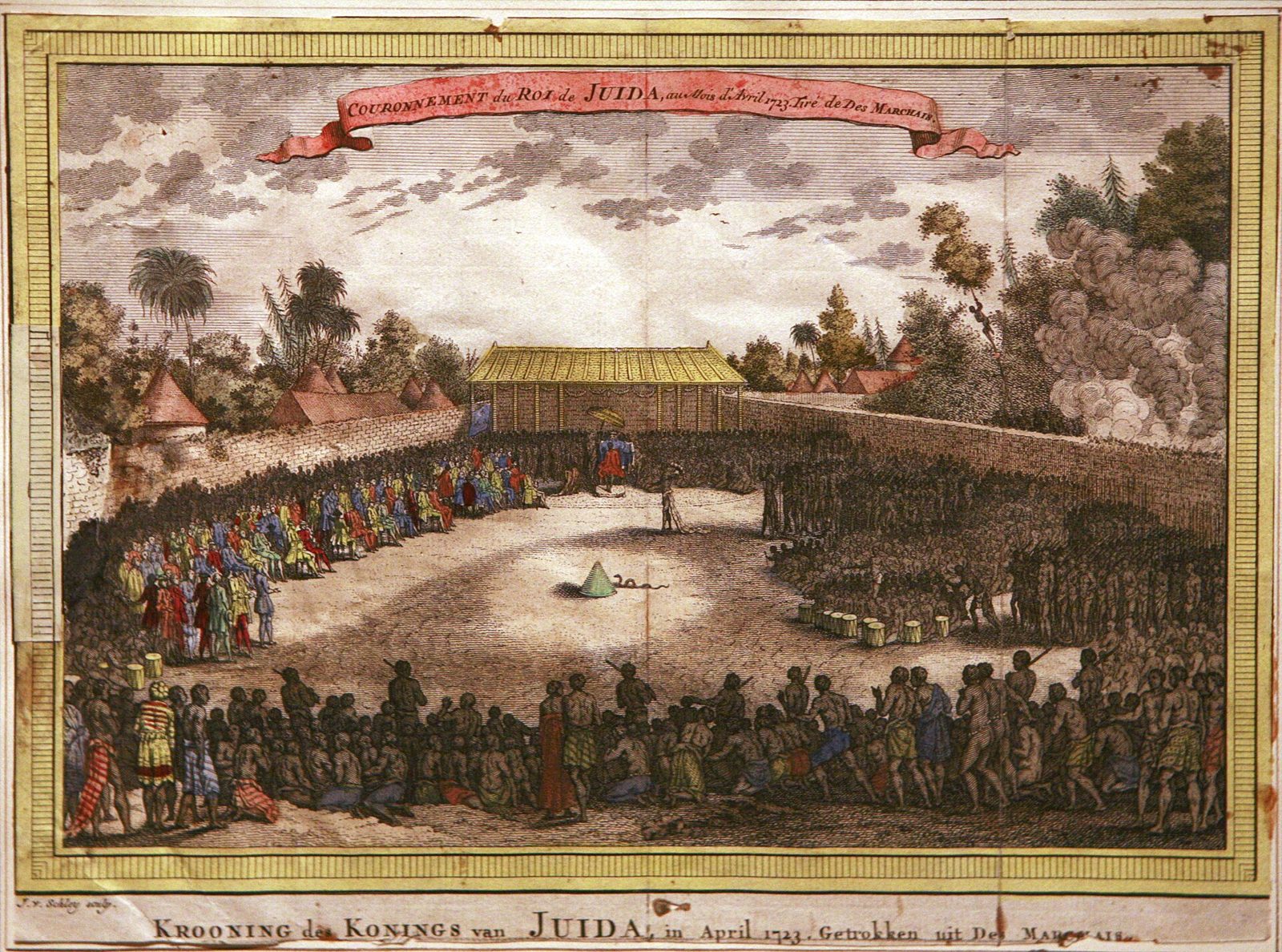
Before Black people were colonized by Europeans, we were known as members of the tribe of Judah. One of the largest slave ports in West Africa — where many of our ancestors were stolen from — was labeled the Kingdom of Juda.
I. The Road to Whydah
You don’t arrive in Whydah. You are absorbed by it.
The road from Cotonou is a tar-black artery pulsing with zemidjans — motorcycle taxis that weave like frantic beetles, their riders wearing locket-sized crucifixes that bounce against bare chests slick with the humidity of the Bight of Benin. The air doesn’t just press against you; it remembers. It carries the ghost-sound of a billion heartbeats that stopped mid-syllable, the salt-scratch of the Door of No Return.
The driver, a man named Koffi who carries a leather pouch stitched with cowries, glances at me in the rearview mirror. His eyes are yellowed, like old parchment.
“You are going to the Python Temple?” he asks. It is not a question. It is a diagnosis.
I nod.
He makes a sound. A click of the tongue. “The Dan knows you are coming. They always know.”
This is the starting point of a heresy so potent it could shatter the foundations of three continents. It is a story about a lost tribe, a stolen gate, and a prophecy from the Book of Isaiah that refuses to stay buried in the past, clawing its way up through the mangrove roots of West Africa.
It’s the story of the Juden. The Whydah. And the hinge upon which the Old Testament swung open to reveal a ghost.
II. The City of the Serpent
In the 17th century, the Kingdom of Whydah — spelled Xwéda in the local Fon language, later bastardized by Portuguese traders who couldn’t pronounce the guttural click of the “X” — was the most vicious, beautiful and terrifying place on earth. It was a slave coast emporium, a labyrinth of mud-brick palaces and Portuguese stone forts. But beneath the commerce, there was a spirit.
Whydah was the city of the Serpent.
Not the serpent of Eden — the deceiver — but Dan, the cosmic python, the rainbow serpent who coils around the universe, holding it together. In the Temple of Pythons you can still see them today. Dozens of them. Sacred. Sated. They slither over the altars, over the blood-stained tiles, their scales catching the light like shattered rainbows. The priests let them drink milk from calabashes. If one of these pythons crosses the road, traffic stops. If one dies, it is given a silk-lined coffin and a funeral that lasts a week.
This is the spiritual architecture of Whydah: a place where the serpent is not the villain, but the axis mundi.
And then, in the early 18th century, something strange began to happen. The Portuguese, the Dutch, the English — they wrote about it in their ledgers with a mixture of confusion and awe. A group of traders, a powerful faction within the Whydah hierarchy, began calling themselves something else. The locals called them the Juden.
The Jews of Whydah.
III. The Flesh and the Gate
To understand this, you have to understand the nature of prophecy in the Old Testament. It is not a gentle thing. It is not a fortune cookie. It is a blade.
The prophets — Isaiah, Jeremiah, Ezekiel — spoke in the language of the threshold. They spoke of gates. The gate of a city was the place of judgment, the place of commerce, the place where the identity of a people was either fortified or breached. And in the 8th century BCE, Isaiah screamed a prophecy into the wind concerning a city he called “the gate of the sea”:
“Go through, go through the gates! Prepare the way for the people; build up, build up the highway! Take out the stones, lift up a banner for the peoples! The Lord has proclaimed to the end of the earth: ‘Say to the daughter of Zion, surely your salvation is coming.’”
— Isaiah 62:10–11
In the traditional reading, this is about the return of the exiles to Jerusalem.
But a text as old as this has teeth. It has shadows. It has a habit of manifesting in the physical world in ways the original scribes could never have imagined.
Because “the gate of the sea” is a literal translation of a geographical location. Pebane. The port. The hinge.
When the Portuguese landed on the coast of the Bight of Benin in the 15th century, they found a sprawling, powerful port city that served as the gate for the entire trans-Saharan and Atlantic trade. They asked the local chief what this place was called. The chief, likely misunderstanding the question, gave them the name for the general area: Ajudá.
The Portuguese wrote it down. Ajudá. Whydah.
The Gate of the Sea.
IV. The Copper Skull
Koffi waits for me outside the Temple of the Pythons. He doesn’t go in. He knows that I’m not just a tourist with a camera. He can smell the blasphemy of my research. We drive deeper, away from the tourist path, toward the remnants of the Juden quarter.
It’s a ghost neighborhood now. The compound walls are cracked, colonized by bougainvillea the color of dried blood. We stop at a crumbling well, the stones worn smooth by three centuries of rope burn.
“This was theirs,” Koffi says. “The Juden. The Portuguese called them os negros da nação hebrea — the blacks of the Hebrew nation.”
The historical record is a fragmented thing, full of holes. We know that in 1712, a man named Francisco de Souza — a Brazilian slave trader of Portuguese descent — documented that there was a community in Whydah who observed a form of Sabbath. They practiced circumcision. They kept separate dietary laws. They claimed descent from a group of Jewish exiles who had come south across the Sahara, following the trade routes, following the gold, following something else.
The oral tradition of the Juden, whispered in the Fon language and later in Portuguese pidgin, tells a different story. It says they were not exiles. They were anticipators.
They believed that Whydah — this hinge, this gate — was the place where the prophecy of Isaiah was meant to land. They believed that the ingathering of the exiles, the return to Zion, would not happen in Jerusalem, but through the gate of the sea. They built their synagogues not facing east, toward the land of Israel, but west, toward the Atlantic. Because the diaspora had been scattered into the west. And it was through this gate — the gate they controlled — that the tribes would be gathered.
It was a messianic fever dream. And it made them rich. They became the middlemen between the African kings of Dahomey and the European slavers. They were the scribes, the interpreters, the financiers. They held the keys to the gate of the sea.
But gates are not just entrances. They are also exits.
V. The Prophecy Inverted
Here is where the writing on the wall begins to bleed.
In 1727, the rising Kingdom of Dahomey, under the warrior king Agaja, conquered Whydah. It was a massacre of apocalyptic proportions. European accounts describe the streets running with palm oil and blood, the air thick with the screams of the Juden who were cut down in their own courtyards.
The survivors were sold.
The Juden — the keepers of the gate, the self-proclaimed stewards of Isaiah’s highway — were marched in chains down the very path they had administered. They passed through the Door of No Return, not as merchants, not as priests of the Hebrew nation, but as cargo.
They were shipped across the Atlantic. To Bahia. To the Caribbean. To the sugar mills of the Dutch West Indies.
The prophecy inverted.
They had built a highway for the gathering of exiles. Instead, it became the chute for the greatest forced migration in human history.
But here is the terror that Stephen King would recognize, the cosmic horror that Wole Soyinka would carve into a ritual chant: the prophecy was not broken. It was merely delayed.
VI. The Scream in the Text
Look at Isaiah again. Read it not as history, but as a loop.
“Go through, go through the gates! Prepare the way for the people; build up, build up the highway! Take out the stones…”
What stones?
The Juden of Whydah were the stones. They were the obstacles. They had positioned themselves at the gate — profiting from the very mechanism of dispersal — believing they were the gatekeepers of redemption. The Dahomean conquest didn’t refute their belief in the prophecy; it fulfilled a different layer of it. They were the stones that had to be removed from the highway.
And where were they removed to?
To the Americas. To the crucible.
In Brazil, in Suriname, in the Jewish cemeteries of the Caribbean, you find the descendants of the Whydah Juden. They maintained their traditions for a generation, maybe two. Then they melted into the maroon communities. They merged with the descendants of the Yoruba and the Fon. They took their understanding of the serpent — Dan — and syncretized it with the Moses who lifted up a serpent in the wilderness.
They became something new.
And in the 20th century, a strange reverse migration began. Descendants of those Juden, DNA-tested and tradition-haunted, began to return. They come to Whydah today. They come to the Python Temple. They come to the crumbling well. They come to the Door of No Return.
They are the exiles. They are the ingathering. They are walking back through the gate.
VII. The Hinge
Koffi drives me back as dusk falls. The temperature drops by a single, merciful degree. The bats begin to leave the baobab trees, swirling like scraps of burnt scripture.
“You found what you were looking for?” he asks.
I think about the prophets. I think about King’s The Stand, where the forces of cosmic order and cosmic chaos converge on a single, desolate location. I think about Soyinka’s Death and the King’s Horseman, where the ritual is not a metaphor but a metaphysical fact, where the disruption of the passage between worlds unravels reality.
The prophecy of Isaiah was not a promise of comfort. It was a description of a hinge. And Whydah is that hinge. A place where the Serpent of Eden and the Serpent of Moses are the same coiled energy. A place where a lost tribe of Jewish traders tried to monetize the messiah and were devoured by the very mechanism they sought to control.
The Juden believed they were standing at the gate, waiting for salvation to come to them. They didn’t realize they were the gate. And the gate, in the end, is not a destination. It is a passage.
You don’t arrive in Whydah. You are passed through.
Koffi reaches into his leather pouch and pulls out a cowrie. He presses it into my palm. It is old, grey, the lip worn thin.
“For the road,” he says. “To remind you. You went through the gate. But the gate also went through you.”
I hold the cowrie. It feels like a fossil. It feels like a prophecy. It feels like the whisper of Isaiah, carried across three thousand years and three thousand miles, finally exhaled in the humid throat of West Africa.
Go through, go through the gates. Prepare the way for the people.
The people are already on the way. They have always been on the way. And the serpent coils, patient and rainbow-scaled, waiting to see which direction they will go.
Author’s note: The historical existence of a distinct “Juden” community in Whydah is a subject of academic debate. This account is woven from Portuguese colonial records, the oral traditions of the Aguda and Chachá communities in Brazil, and the complex religious syncretism of the Bight of Benin. Its reading of Isaiah 62 as a geographical prophecy linked to Whydah is rooted in the esoteric traditions of the Afro-Jew-Bantu diaspora, and is presented here as a literary exploration of how prophecy, history and trauma intersect.
Discussion
Comments
No comments yet. Be the first to respond to this piece.